
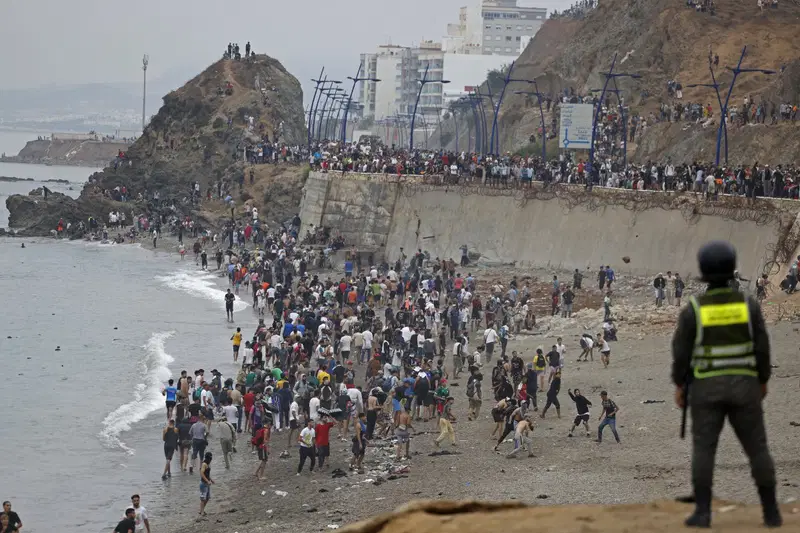
Spanish enclave Ceuta receives 60,000 migrants in just one day, local authorities say
Spanish Enclave Ceuta Receives 60,000 Migrants in Just One Day, Local Authorities Say CEUTA, Spain – In what local officials are calling an “unprecedented humanitarian and security crisis,” the Spanish enclave of Ceuta on the North African coast received more than 60,000 migrants in a single 24-hour period, according to a statement released by the city’s emergency coordination center late Tuesday.The mass arrival, which began in the early hours of Monday morning, has overwhelmed the tiny autonomous city’s infrastructure, stretched local law enforcement to its breaking point, and ignited a fresh political firestorm between Spain and Morocco, whose border guards were notably absent from their usual posts along the perimeter fence.
A Sudden Surge witnesses described scenes of chaos as thousands of people, many of them young men from sub-Saharan Africa, swam around the breakwater that separates Ceuta from Morocco or climbed over the border fence using makeshift ladders and hooks. Others simply walked across the beach at Tarajal, the enclave’s southernmost point, as Moroccan security forces stood by without intervening.By midday Monday, the narrow streets of Ceuta were filled with exhausted migrants, many dripping wet and shivering despite the Mediterranean sun. Local residents, caught off guard by the sheer scale of the influx, began distributing bottles of water, sandwiches, and blankets from their balconies and car windows.”We have never seen anything like this,” said Javier Martínez, a 47-year-old shopkeeper in the center of Ceuta. “I’ve lived here my whole life, and I’ve seen groups of 100 or 200 people cross before. But 60,000? That’s almost the entire population of our city.
It’s impossible to process, impossible to house, impossible to manage.”The Number according to the Ceuta government’s official count, the 60,000 figure includes both those who entered by land and those who arrived by sea. Of that total, approximately 8,000 were minors, many unaccompanied. The majority of the migrants were from Mali, Guinea, Côte d’Ivoire, Senegal, and The Gambia, though a significant number were also reported to be from Morocco itself.Local authorities have scrambled to establish temporary shelters, converting sports halls, school gymnasiums, and even abandoned warehouses into emergency accommodation. However, with capacity for fewer than 2,000 people in existing reception centers, the vast majority of migrants have been left to sleep in the streets, parks, and along the seafront promenade.
“We are doing everything we can, but we are out of resources,” said Juan Jesús Vivas, the mayor-president of Ceuta, in a televised address late Tuesday. “Our police force is exhausted. Our social services are overwhelmed. Our hospitals are running low on supplies. We have activated every emergency protocol we have, but this is beyond anything we have ever planned for.”The Moroccan Factor the timing and scale of the mass crossing have raised serious questions about Morocco’s role in the crisis. The North African kingdom, which has historically cooperated with Spain to curb irregular migration, appeared to relax its border controls for several hours on Monday, allowing thousands to gather at the fence and swim around the sea barrier.Spanish Prime Minister Pedro Sánchez cut short a trip to Brussels to return to Madrid for an emergency cabinet meeting, where he condemned what he called Morocco’s “blackmail” tactics.
In a fiery press conference, Sánchez accused Rabat of using migration as a political weapon in a growing diplomatic dispute over Western Sahara.”This is not a natural phenomenon,” Sánchez said. “This is a calculated act of pressure against Spain and against Europe. We will not be intimidated, and we will not accept that the lives of thousands of vulnerable people be used as pawns in a geopolitical game.”Spain and Morocco have been locked in a tense standoff since mid-April, when Madrid admitted the leader of the Western Sahara independence movement, Brahim Ghali, for medical treatment. Rabat reacted with fury, recalling its ambassador to Spain and warning of “consequences.” Many analysts now believe the mass migration event is the first clear manifestation of those consequences.Humanitarian Crisis Unfolds As night fell on Tuesday, the situation on the ground in Ceuta was growing increasingly desperate. Aid organizations reported that many migrants were suffering from hypothermia, dehydration, and injuries sustained during the crossing.
At least one person died attempting to swim around the breakwater, and several others were hospitalized with severe wounds from the razor wire atop the border fence. “These are people who have walked thousands of miles across the Sahara, who have survived brutal conditions in Libyan detention centers, who have risked their lives on overcrowded boats—and now they find themselves in a European city that cannot take them in,” said María Gómez, a field coordinator for the Spanish Red Cross. “The trauma is palpable. They are scared, confused, and exhausted. “The Red Cross, along with Médecins Sans Frontières and other NGOs, has set up mobile clinics to provide basic medical care, but supplies are running dangerously low. Local pharmacies have been stripped of antibiotics, bandages, and painkillers. “We are seeing a lot of respiratory infections, skin diseases from the seawater, and untreated wounds,” said Dr. Ahmed El-Mansouri, a volunteer physician. “We also have cases of severe psychological distress—people who are disoriented, who are crying uncontrollably, who cannot tell us their names or where they came from. “Political Reactions Across Europe the crisis in Ceuta has sent shockwaves through European capitals, reigniting longstanding debates over migration policy, border security, and the externalization of EU frontiers.
European Commission President Ursula von der Leyen expressed “solidarity with Spain” and offered logistical and financial support, but stopped short of calling for collective EU action.”This is a Spanish issue, but it is also a European one,” von der Leyen told reporters in Strasbourg. “We are in contact with the Spanish authorities and we are ready to assist. But we must also address the root causes of migration—poverty, conflict, climate change—and work with our partners in Africa to create legal pathways.”France, Germany, and Italy have all voiced concern, though none have offered to take in any of the migrants from Ceuta. The European Border and Coast Guard Agency, Frontex, has deployed additional surveillance aircraft to the region, but has not sent ground personnel.
Interior Minister Fernando Grande-Marlaska announced that Spain would begin returning migrants to Morocco under a bilateral readmission agreement, a move that has drawn sharp criticism from human rights groups. “You cannot send people back to a country where they have no legal status and where they may face arbitrary detention or deportation further south,” said Marta González, a lawyer with the Spanish Commission for Refugees (CEAR).Ceuta’s Identity Under Strain for the people of Ceuta, the mass arrival has forced a reckoning with their city’s precarious position as a European outpost on the African continent. With a population of just 85,000, the enclave is smaller than many European suburbs, yet it now hosts more than two-thirds of that number in migrants. “This is a city that has always been a bridge between two worlds,” said Fatima Benjelloun, a historian and local activist. “We are Spanish, but we are also Moroccan in our food, our music, our way of life. We have always had a complicated relationship with our neighbors. But this—this feels like an invasion, and it is terrifying. “Some residents have expressed sympathy for the migrants, sharing food and water despite official warnings not to “encourage” further crossings.
Others have voiced anger and fear, organizing nighttime patrols to protect their neighborhoods and demanding that the Spanish government send the army to restore order. “We cannot accept this,” said Luis Pérez, a retired civil servant standing near the border fence. “We are a small city. We cannot absorb 60,000 people. We don’t have the schools, the hospitals, the jobs. The government in Madrid has abandoned us. We feel completely alone.”The Journey Behind the Crossing to understand the magnitude of the crisis, one must look beyond Ceuta’s shores to the vast, perilous routes that bring migrants from the heart of Africa to the Mediterranean coast. For most of those who arrived on Monday, the journey began months or even years earlier. According to interviews conducted by aid workers, many of the migrants had been living in Morocco for extended periods, working menial jobs and saving money to make the final crossing.
Others had recently arrived in Morocco after escaping violence or poverty in their home countries, only to find that the Moroccan government had tightened its own borders and cracked down on informal settlements.”I left Mali because my village was destroyed by fighting,” said Aboubacar Diallo, a 24-year-old who crossed into Ceuta on Monday morning. “I walked for three months to get to Morocco. I worked in a construction site in Fès for eight months. But the police kept arresting us, and we couldn’t get papers. When we heard that the border was open, we ran. We had no choice. “Diallo is now sleeping on a concrete floor in a converted gymnasium, alongside hundreds of other men, women, and children. He has no idea what will happen next. “I don’t want to go back to Morocco. I don’t want to go back to Mali. I want to go to Spain, to France, to anywhere where I can work and live in peace.
“Economic Realities the economic dimensions of the crisis are impossible to ignore. Ceuta, which relies heavily on cross-border trade with Morocco and tourism from the Spanish mainland, has seen its economy battered by the pandemic and now faces the prospect of a prolonged disruption. Border crossings between Morocco and Ceuta have been closed since March 2020 due to COVID-19, choking off the flow of goods and workers that sustained much of the local economy. Monday’s events have further complicated efforts to reopen the border, with Spanish officials now warning that security concerns must take precedence.”This is a disaster for our businesses,” said Carlos Ruiz, president of the Ceuta Chamber of Commerce. “We are already struggling to survive. If this situation continues, if the border remains closed, if we are seen as a city in crisis, tourists will not come, investors will not come. We will be destroyed.”The Role of Social MediaOne of the most striking aspects of the mass arrival has been the role of social media in coordinating and amplifying the event.
Migrants used WhatsApp and Facebook groups to share real-time information about gaps in the fence, the location of police patrols, and the safest crossing points. Moroccan authorities have reportedly arrested several individuals accused of organizing the crossings, but the decentralized nature of the communication has made it difficult to identify leaders or masterminds. Some Spanish politicians have called for closer scrutiny of digital platforms, arguing that they enabled the “mass organized assault” on Ceuta’s borders. “We cannot allow these platforms to be weaponized against our sovereignty,” said opposition leader Pablo Casado. “There must be accountability. Those who incited this chaos must face justice. “Spain’s Diplomatic Dilemma for Prime Minister Sánchez, the Ceuta crisis represents one of the most serious challenges of his tenure.
His government has been forced to navigate a delicate balancing act: demonstrating strength and resolve to domestic audiences while avoiding a full-blown rupture with Morocco, a key partner in counterterrorism, trade, and migration control.Sánchez has ordered the deployment of 500 additional troops to Ceuta and pledged to repatriate all migrants who are not eligible for asylum. But his options are limited. Morocco has made clear that it will not accept mass returns without a broader political agreement, and the European Union has shown little appetite for confronting Rabat directly.”This is a test of Spain’s diplomatic capacity,” said Dr. Elena García, a professor of international relations at the Complutense University of Madrid. “Sánchez needs to send a message that Spain cannot be pushed around, but he also cannot afford to break ties with Morocco. The relationship is too important on too many levels. He is walking a tightrope.”Human Rights Concerns Amid the political maneuvering, human rights advocates have warned that the rights of migrants must not be sacrificed in the name of border control.
Spain has a legal obligation under international law to screen all arrivals for asylum claims and to refrain from collective expulsions.”We are already hearing reports of summary returns,” said Marta González of CEAR. “People are being taken to the border and pushed back without any individual assessment of their situation. That is illegal. That is dangerous. And it will not solve the underlying problem.”United Nations officials have echoed these concerns, calling for “calm and restraint” and urging both Spain and Morocco to “respect their obligations under international refugee and human rights law.”The View from Rabat Moroccan officials have remained largely silent on the details of the crossing, but sources close to the government have suggested that the move was intended to “remind Spain of the cost of its arrogance.”
The Ghali affair, they argue, was a profound insult to Moroccan sovereignty, and Spain must pay a price.”There was a red line, and Spain crossed it,” said a Moroccan diplomatic source, speaking on condition of anonymity. “We are not responsible for the actions of individuals who choose to migrate. We are simply allowing natural movements to take their course. If Spain wants our cooperation, it must show respect.”Long-Term Implications as the days go by and the migrants remain in limbo, the long-term implications of the Ceuta crisis are beginning to crystallize. For Spain, the event has exposed the fragility of its southern border and the extent of its dependence on Moroccan goodwill.
For Europe, it has underscored the persistence of migration as a defining political issue—one that cannot be outsourced or ignored.For the migrants themselves, the future remains deeply uncertain. Some will be returned to Morocco, where they may face detention or deportation. Others will be granted asylum in Spain and eventually relocated to other parts of the country. A few may even succeed in reaching other European destination. But for the 60,000 who arrived in Ceuta on Monday, the dream of a better life has collided with the harsh realities of geopolitics, bureaucracy, and limited resources.
In a city that has long stood at the crossroads of two continents, they wait—for food, for shelter, for news, for a chance to move forward.Conclusion: A City Transformed Ceuta will never be the same. The arrival of 60,000 migrants in a single day has not only overwhelmed its physical infrastructure but also challenged its identity, its politics, and its relationship with its Moroccan neighbors.
Whether this moment becomes a turning point toward greater European solidarity or a flashpoint for further confrontation remains to be seen.What is clear is that the human beings at the center of this story—each with their own name, their own history, their own reasons for leaving home—are more than statistics.
They are mothers and fathers, sons and daughters, dreamers and survivors. And they have, at least for now, arrived at Europe’s doorstep, asking for nothing more than the chance to begin again.As Mayor-President Vivas put it in his address: “We are a small city with a big heart. But our heart is breaking today. We need help. We need Europe to see us, to hear us, and to act. Not tomorrow. Today.”—Editor’s Note: This story is developing. Authorities expect the number of arrivals to continue fluctuating as repatriation efforts get underway and as additional groups gather on the Moroccan side of the border. The Spanish government has announced it will provide a full update on Wednesday afternoon.
Hi, this is a comment.
To get started with moderating, editing, and deleting comments, please visit the Comments screen in the dashboard.
Commenter avatars come from Gravatar.